
Track: Revision Arthroplasty and Complication Management
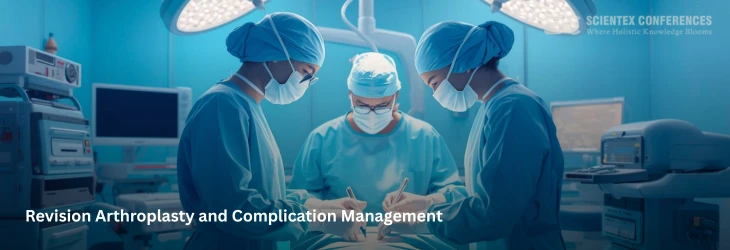
Revision arthroplasty represents one of the most technically demanding areas of orthopedic surgery, requiring a clear understanding of why the original implant failed. This session builds directly on themes explored in hip and knee arthroplasty and implant design, biomaterials, and biomechanics, examining how earlier surgical and material decisions influence the complexity of later revision cases.
Key Topics and Highlights:
Diagnosing Implant Failure: Distinguishing between aseptic loosening, infection, instability, and wear-related failure requires careful diagnostic workup. This sub-topic reviews current clinical, radiographic, and laboratory approaches.
Periprosthetic Joint Infection Management: Infection remains one of the most challenging revision scenarios. This subtopic covers current evidence on one-stage versus two-stage revision protocols and emerging diagnostic markers.
Managing Bone Loss in Complex Revisions: Significant bone loss requires specialized reconstructive strategies. This subtopic explores the use of augments, allografts, and revision-specific implant systems.
Reducing Revision Rates Through Primary Surgery: Many revision cases can be prevented through improved primary technique and implant selection. This subtopic connects back to strategies discussed in hip and knee arthroplasty for reducing long-term complication risk.
Patient Experience and Recovery After Revision: Revision surgery often carries a longer, more complex recovery. This sub-topic addresses strategies for managing patient expectations and functional recovery.
If your research addresses implant failure, revision technique, or complication prevention, we welcome you to submit an abstract and share your findings with surgeons managing some of the most complex cases in orthopedics.
Scientific Highlights
- Advances in Hip and Knee Arthroplasty
- Implant Design, Biomaterials, and Biomechanics
- Revision Arthroplasty and Complication Management
- Shoulder and Elbow Reconstruction
- Foot and Ankle Surgery
- Robotic and Computer Assisted Orthopedic Surgery
- Minimally Invasive and Arthroscopic Techniques
- 3D Printing and Digital Technology in Orthopedic Surgery
- Artificial Intelligence and Data Driven Orthopedics
- Regenerative Medicine and Stem Cell Therapy in Orthopedics
- Arthritis, Osteoporosis, and Degenerative Joint Disease
- Orthopedic Oncology
- Pediatric Orthopedics
- Geriatric Orthopedics and Bone Metabolic Disorders
- Sports Medicine and Soft Tissue Injuries
- Orthopedic Trauma and Fracture Management
- Spine and Spinal Disorders
- Orthopedic Rehabilitation and Physiotherapy
- Orthopedic Pain Management and Anesthesia
- Ethics, Patient Safety, and Value Based Orthopedic Care
- Innovations and Future Directions in Arthroplasty

Organization Location
1309 Coffeen Avenue, STE 1200, Sheridan, Wyoming 82801, USA
General Enquiry
contact@scientexconferences.com
Finance Enquiry
finance@scientexconferences.com
Call us at
USA : (+1) 914 520 5013